Step Back in Time: Inside the W.A. Silva Museum in Colombo 06
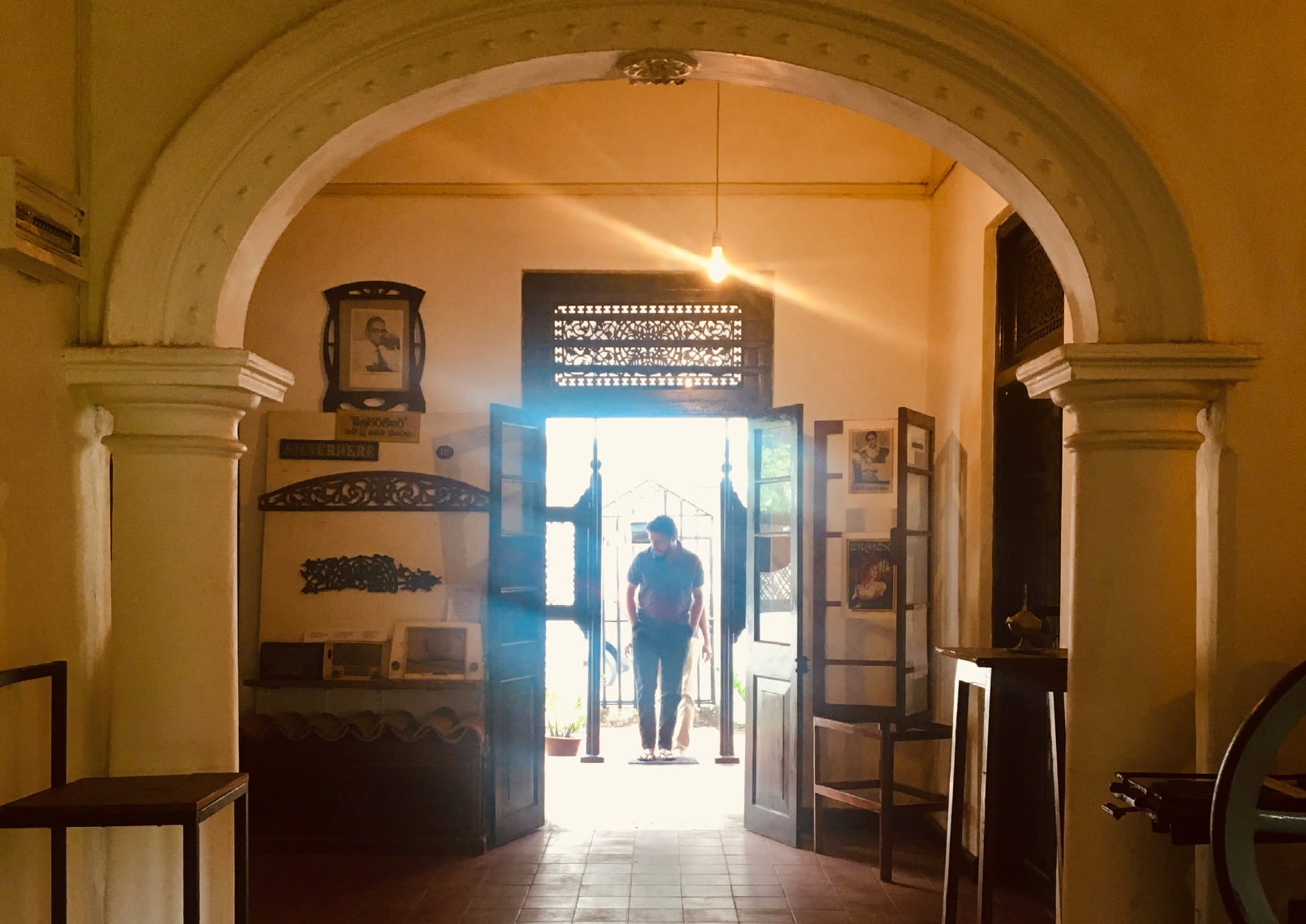
If you drive through Wellawatte today, the hustle and traffic can make it easy to miss the historical gems hidden right in plain sight. Today, I took a detour down W.A. Silva Mawatha to visit a place I’d been meaning to check out for a while: The W.A. Silva Museum, housed in “Silvermere,” the historic home of one of Sri Lanka’s most important novelists.
This was actually an entirely unplanned trip, and I was absolutely amazed to run into my senior from school, Sajaan Peiris, who is the curator currently running the space. Getting to experience this piece of Sri Lankan history firsthand-guided by a school senior who clearly treats this building less like a job and more like a calling-was an absolute privilege. Whether you’re a literature buff, a design nerd, a history enthusiast, or just a wanderer looking for a quiet escape in Colombo 06, this place matters. Here’s everything you need to know.
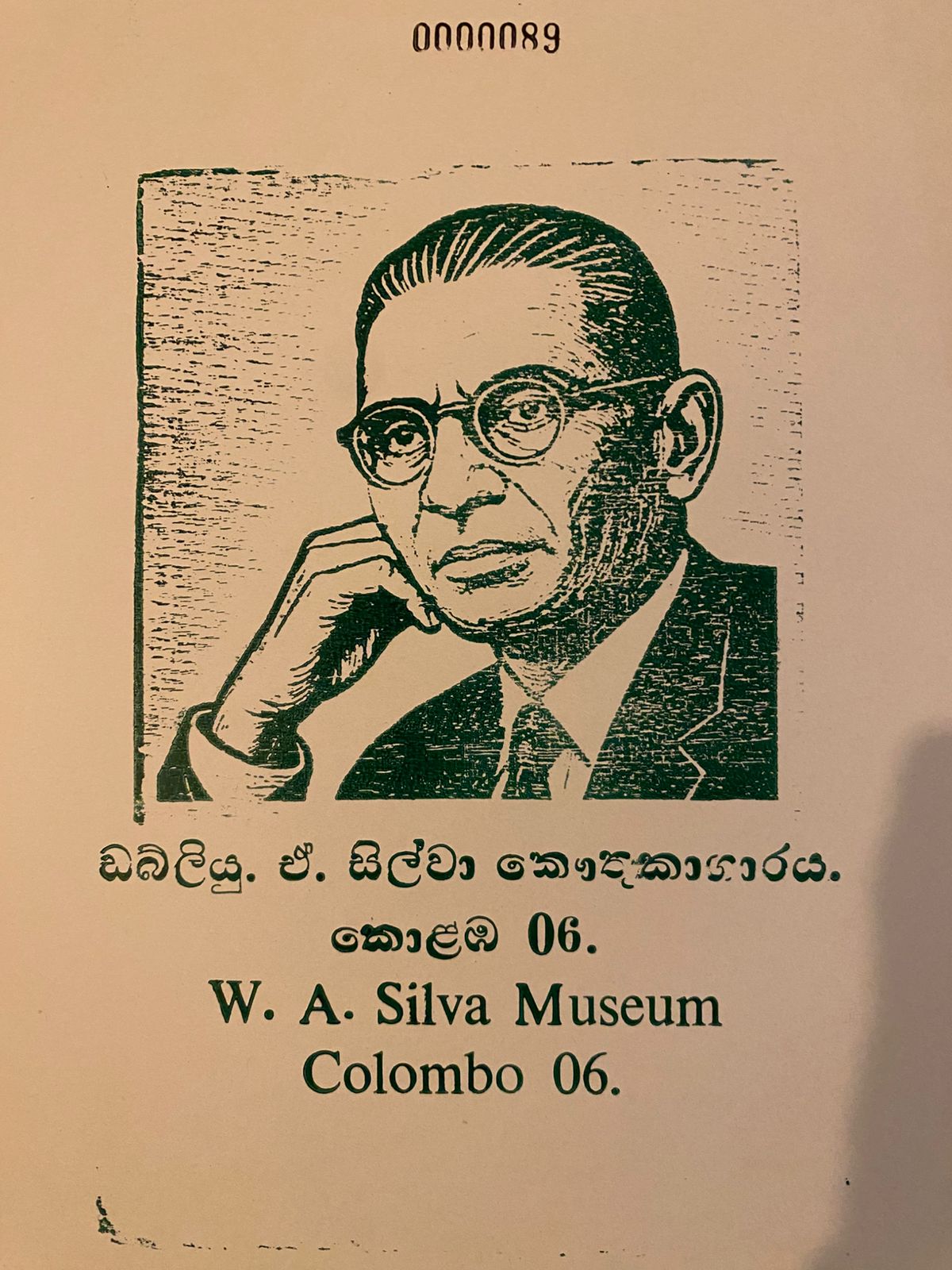 The museum’s own printed emblem - a portrait of W.A. Silva, stamped in the same letterpress tradition the museum now preserves.
Who Was W.A. Silva?
Before we talk about the museum, we have to talk about the man. Wellawattearachchige Abraham Silva (1890–1957) wasn’t just a writer; he completely reshaped Sinhala literature, and is still remembered as the ‘Chakravarti’ - the “universal ruler” or “emperor” - of the Sri Lankan novel.
- A prodigy. After a formal Sinhala education (his schooling stopped at the fifth grade, and he later worked as a junior clerk while studying Sanskrit and Sinhala under Ven. Pelane Sri Vajiragnana Thero in his own time), Silva wrote his first novel, Siriyalatha, at just 16 years old. His second, Lakshmi, followed in 1922.
- The silver screen. His novel Kele Handa made history as the first-ever Sinhala novel adapted into a film, and Hingana Kolla and Siriyalatha itself later received the same treatment.
- Master of genres. From the historical epic Vijayaba Kollaya to romance, detective fiction, and adventure, Silva introduced Western literary styles and structures to Sri Lankan readers while keeping the storytelling deeply local.
- A self-made publisher. Getting published in early 20th-century Ceylon wasn’t easy, so Silva took matters into his own hands. Alongside his novels, he edited the magazines Siri Sara (1919–1923) and Nuwana (1940–1946), and ran his own weekly newspaper, Lanka Samaya (from 1933) - building the print infrastructure to get his and others’ stories in front of readers, long before “self-publishing” was a common idea anywhere in the world.
He lived in this house, which he and his circle nicknamed Silvermere (Silumina Mandiraya), until his death on 3 May 1957. In his lifetime, the place was less “writer’s quiet retreat” and more informal literary salon - the backyard porch reportedly buzzing with debates, readings, music, and food shared among Colombo’s literary and artistic set.
Inside “Silvermere”: Why This Museum Matters
The museum is housed in Silva’s actual former home - walking through the doors feels like stepping into a 19th-century time capsule. After his death, the house sat abandoned for decades, slowly stripped of its personal warmth, before the W.A. Silva Foundation stepped in and reopened it to the public. Today it’s co-run with the Akuru Collective and the Institute of Typography Sri Lanka, which has grown the museum’s mission well beyond one novelist’s legacy into an active centre for Sinhala and Tamil language, script, and print heritage.
What makes it so fascinating isn’t just a display of old books behind glass - it’s the mechanical history of storytelling. In an era before digital typesetting, publishing a book was brutally labour-intensive, letter by letter. Silva himself built and ran his own printing operation to get his novels, magazines, and newspaper into readers’ hands. Seeing the actual heavy iron machinery of that era, still on-site and still functional, gives you a whole new appreciation for the grit it took to be a working author and publisher a century ago.
The Star of the Show: The Hopkinson & Cope Printing Press
The biggest highlight of my visit was watching a genuinely rare piece of engineering come alive. Sajaan and his team are introducing live, interactive demonstrations of a fully functional antique Hopkinson & Cope “Albion” hand-press, cast in iron in Finsbury, London.
Watch Curator Sajaan Peiris and the team demonstrate the historical 19th-century Hopkinson & Cope "Albion" hand-press.
A little history: the Albion press was originally designed around 1820 by Richard Whittaker Cope of London. After Cope’s death in 1828, his foreman John Hopkinson took over the business, and by the 1840s the firm’s presses carried the name cast right into the ironwork - “Hopkinson & Cope, Finsbury, London,” with “Patent” stamped into the uprights, exactly as it appears on the museum’s press. Albion presses like this one were manufactured continuously in Britain for well over a century, used first for commercial book printing and, from the mid-1800s onward, chiefly for proofing, fine jobbing work, and private presses. To see a piece of this vintage still operational in 2026 is nothing short of magic.
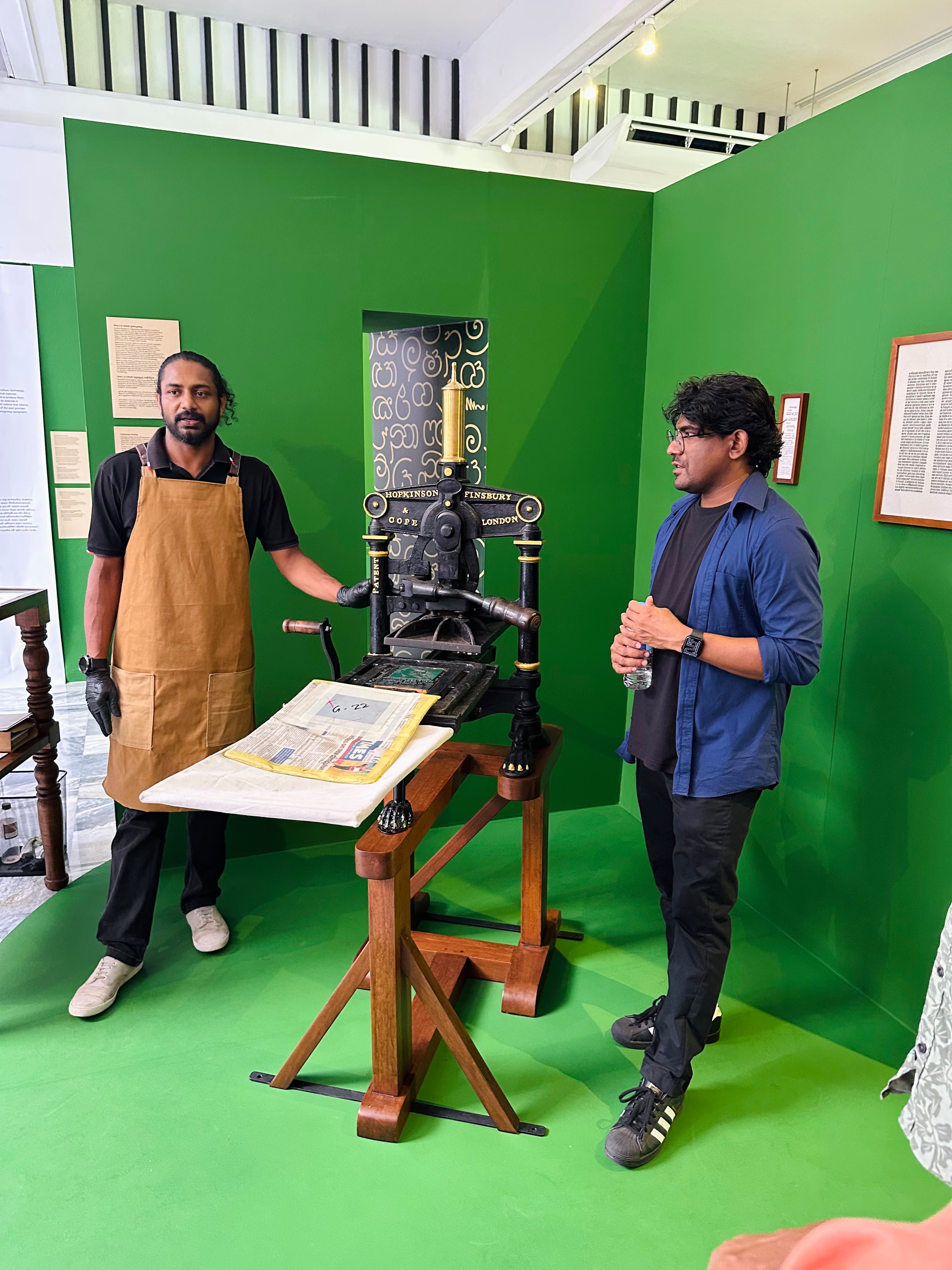 Sajaan Peiris introduces the museum’s fully functional Hopkinson & Cope Albion press.
How the magic happens, step by step:
- Inking the plate. Rich green ink is rolled out on a glass slab using a hand roller (brayer) until it forms a smooth, tacky, even coat.
- Coating the block. The ink is meticulously rolled over a custom-carved relief block featuring a striking portrait of W.A. Silva.
- Setting the paper. A sheet of paper is carefully aligned on the press bed, held in place under a padded frame called the tympan.
- The impression. The bed is wound under the heavy iron platen, and with a firm, satisfying pull of the cast-iron lever, real pressure transfers the ink to the page - no motor, no electricity, just leverage and a toggle joint.
- The reveal. The press rolls back, the paper peels away, and a crisp, freshly printed portrait of W.A. Silva appears - complete with the faint indentation in the paper that modern digital printing simply can’t replicate.
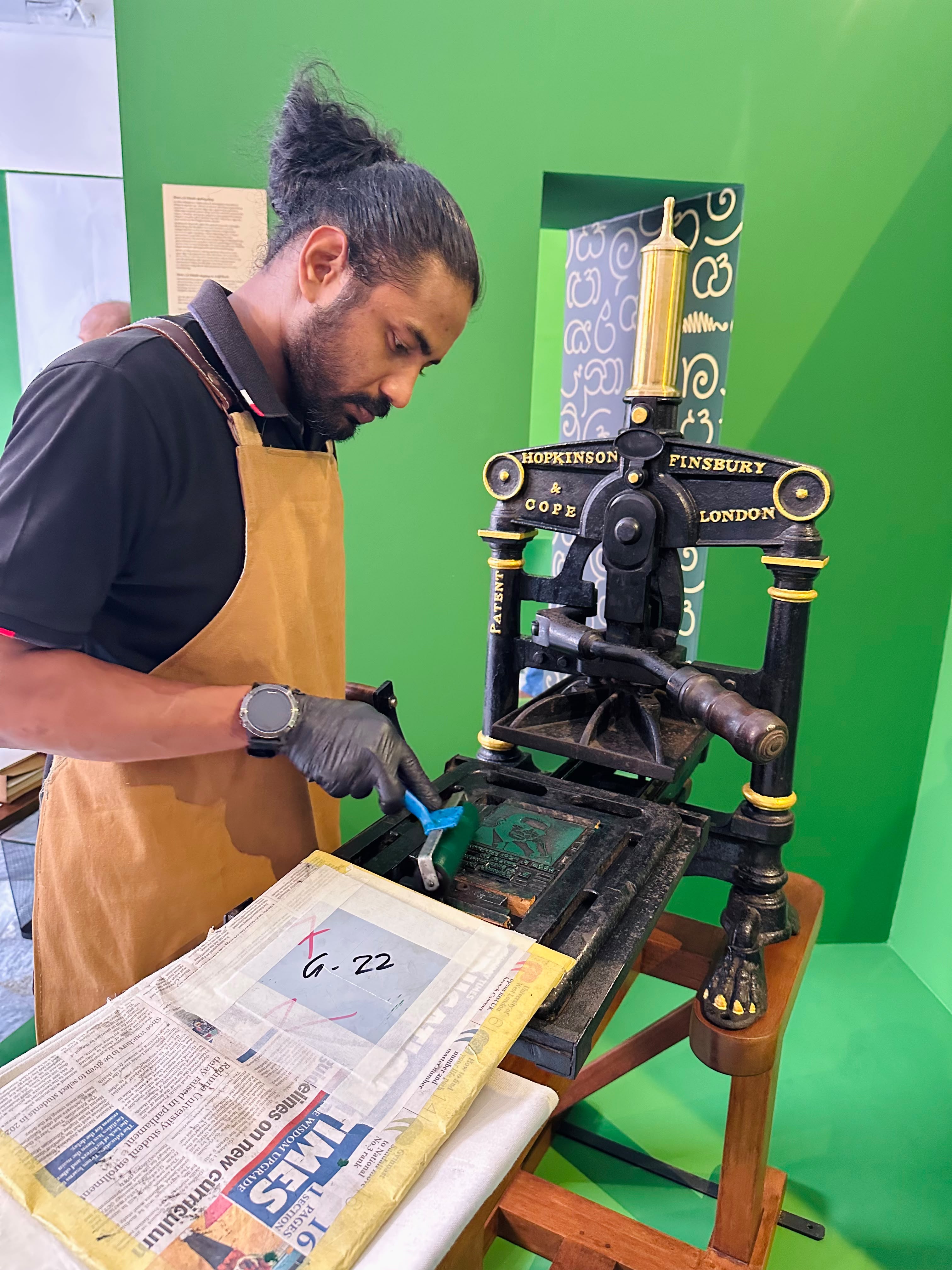 Inking the relief block - the first step of a genuinely hands-on print.
This demonstration connects you directly to how Silva’s earliest novels, magazines, and newspaper were physically built - sheet by sheet, on machines not so different from this one.
What Else Can You See? A Tour of the Exhibits
The museum has been thoughtfully curated to balance historical preservation with genuinely striking modern design. Here’s what else stood out on my walk-through:
The typography and typeface wall. As a design enthusiast, this section blew me away - massive, floor-to-ceiling installations celebrating the evolution of Sinhala, Tamil, and English scripts. You’ll see close-up studies of contemporary local typefaces like Yaldevi (a sleek, slightly condensed multiscript face built for Sinhala, Tamil, and English) and Maname (a versatile, harmonised typeface for Sinhala and English), showing just how expressive modern local type design has become.
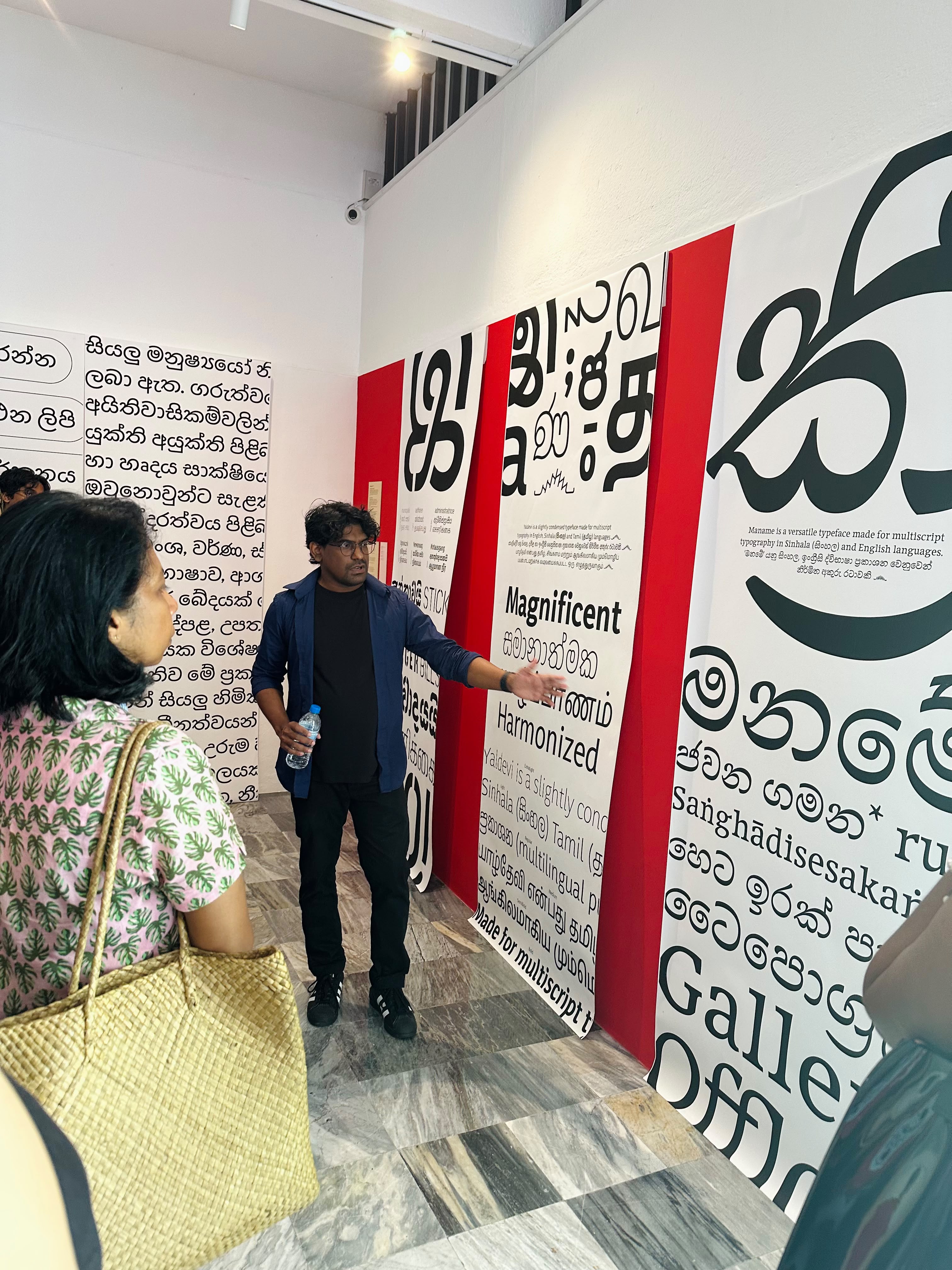 Contemporary Sinhala and Tamil typefaces on display, including Yaldevi and Maname.
A tactile “personality of fonts” display. In the centre of the exhibition hall sits a fascinating interactive installation: circular grey platters holding 3D-moulded Sinhala, Tamil, and English words - including a striking set spelling “STRONG.” The physical depth and curve of the letterforms let you literally feel the visual weight and character behind different typefaces, turning the abstract idea of typography into something tangible and touchable. This ties directly into the museum’s broader wood-type conservation project, which actively buys back old wooden printing type from local printers before it’s lost for good.
The literary archive and memorabilia. Naturally, the museum preserves the soul of Silva’s life and work - original first editions of novels including Siriyalatha, Kele Handa, and Vijayaba Kollaya; handwritten manuscripts, personal letters, and vintage photographs; and historic metal and wood typography blocks used in early Sri Lankan printing.
The serene inner courtyard. After soaking in the design and machinery, step out into a beautifully manicured, minimalist garden - a lush green backdrop with a few historic curiosities, including a vintage trilingual Yakkala (යක්කල) road-sign display, built around a real sign for the town of Yakkala using a typeface commissioned by Sri Lanka’s Road Development Authority. It’s a peaceful sanctuary that makes you forget you’re standing in the middle of busy Colombo 06.
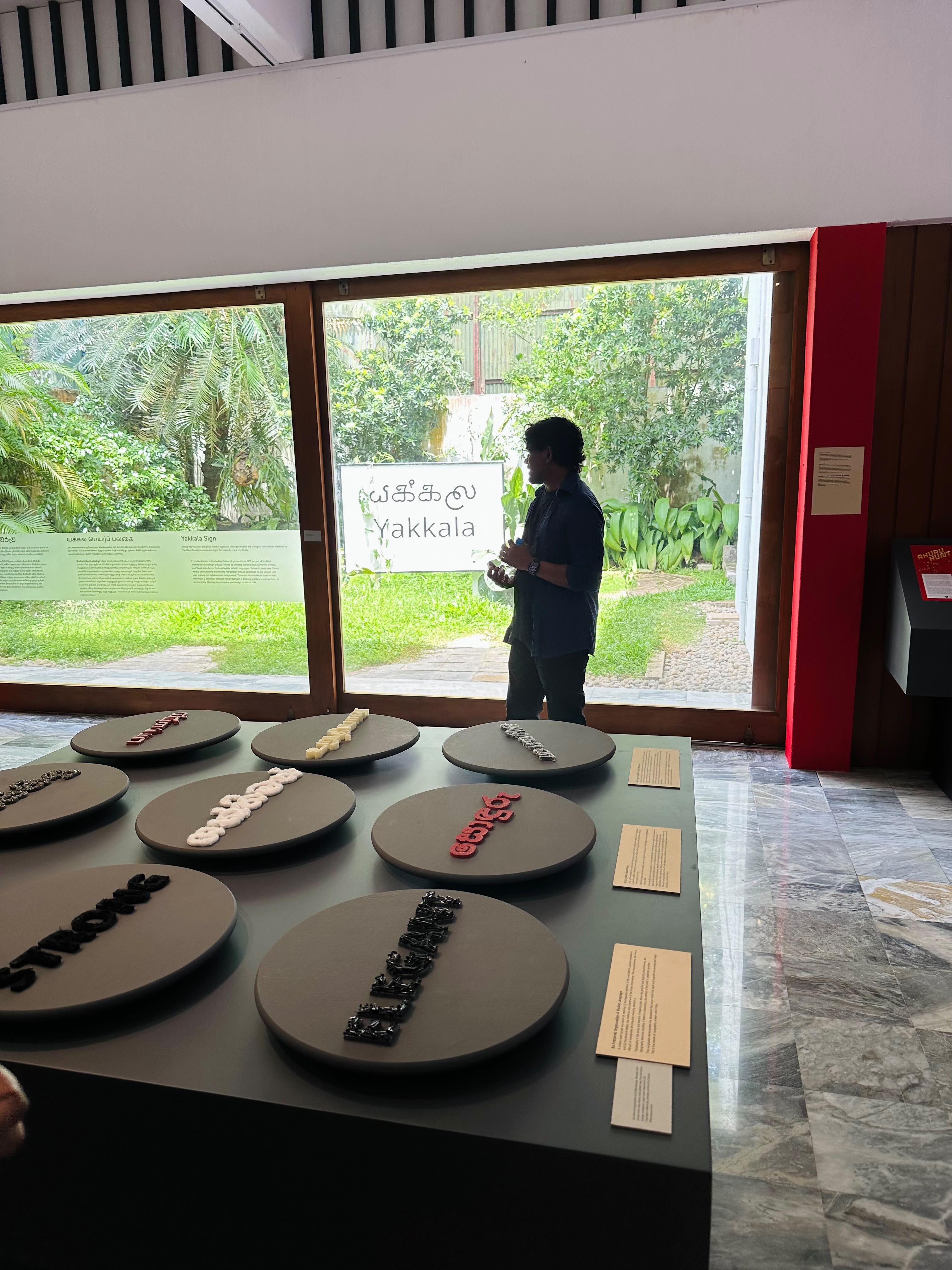 The Yakkala road-sign exhibit, with the garden courtyard just beyond.
Why the W.A. Silva Museum Matters
W.A. Silva was a visionary who didn’t just write stories - he built the literal machinery to publish them when mainstream channels weren’t enough. By combining his literary genius with his own printing operation, he democratised storytelling in early 20th-century Sri Lanka. Thanks to the creative curation of Sajaan Peiris and the wider Akuru Collective team, this museum doesn’t just look back at that legacy - it actively celebrates the timeless craft of communication, design, and human ingenuity, with a working 19th-century printing press as the connective thread between past and present.
How to Visit
- Location: 126 W.A. Silva Mawatha, Wellawatte, Colombo 06
- Admission: Free
- Time needed: 30–45 minutes for a proper look; longer if there’s a live demonstration or event on
- Website: W. A. Silva Museum’s official website
- Don’t miss: Ask the team for a live demonstration of the Hopkinson & Cope press - it’s the single best reason to visit with a guide rather than browsing alone
If you’re ever in Colombo 06, do yourself a favour and drop by. It’s a beautiful, hands-on tribute to a man who shaped Sri Lankan storytelling - preserved, printed, and kept running by a small team stubborn enough to keep the ink wet.
The Wanderer - July 17, 2026