Sky-High Fortresses and Golden Caves: The Ultimate Guide to Sigiriya & Sri Lanka’s Cultural Triangle
There is a distinct kind of magic that happens in the heart of Sri Lanka’s Central Province. One minute you are walking through dense, emerald-green jungles, and the next, you are staring up at a sheer, 200-meter vertical wall of granite rising dramatically out of the plains.
Welcome to the Cultural Triangle. If you’re pulling together an itinerary for Sri Lanka, this region is an absolute non-negotiable. From dark royal betrayals and ancient engineering marvels to misty sunrise balloon rides, here is everything you need to see, do, and experience around Sigiriya and Dambulla.
1. Sigiriya Rock Fortress (The Lion Rock)
You can’t write about this region without starting here. Sigiriya is a UNESCO World Heritage site and is widely considered by locals and travelers alike to be the “Eighth Wonder of the World.” It is not just a geological anomaly; it is a mind-blowing feat of ancient urban planning, art, and engineering.
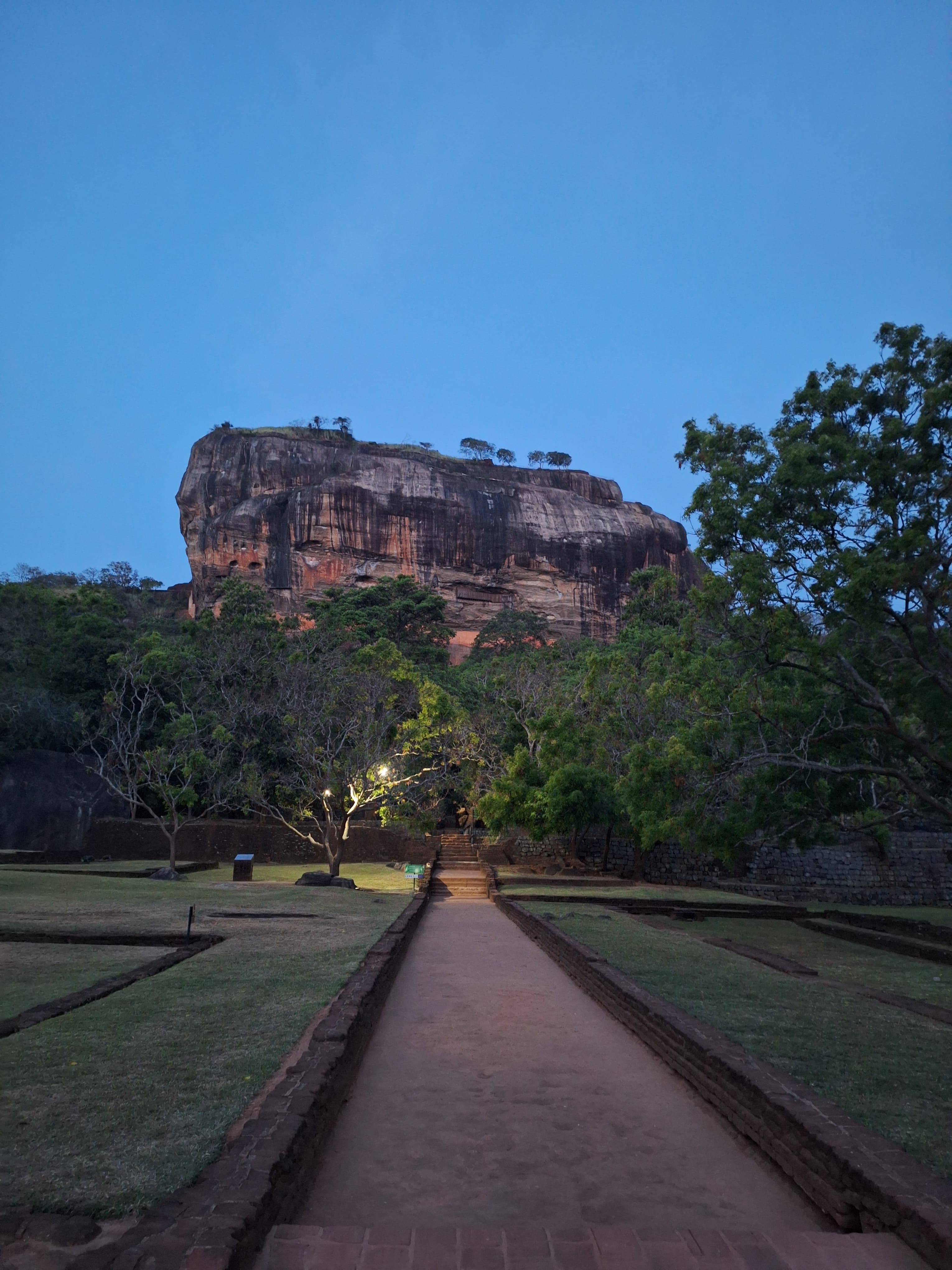 Looking straight up at the towering monolith of Sigiriya Rock early in the morning. As the dawn light breaks over the horizon, artificial spotlights illuminate the base paths and the lower forest canopy, emphasizing the sheer verticality and scale of King Kashyapa’s ancient mountain retreat.
The Dark History: King Kashyapa’s Citadel of Fear
To truly appreciate Sigiriya, you have to understand the blood-soaked soap opera behind its creation. Built in the 5th century (477–495 CE), the fortress was born out of fear and ambition.
King Kashyapa, the rogue son of King Dhatusena, seized the throne by overthrowing his father and—in a brutal twist of history—walling the old king alive. Fearing a rightful retaliation from his exiled half-brother, Moggallana, Kashyapa abandoned the traditional royal capital of Anuradhapura. He fled into the jungle and transformed this massive volcanic plug into an unassailable, heavily fortified palace in the clouds.
Why Sigiriya is Globally Important
Sigiriya is one of the best-preserved examples of ancient urban planning in Asia. It showcases an unparalleled fusion of nature and human imagination. The site is divided into a complex tapestry of symmetrical ramparts, deep moats, pleasure gardens, and monastic complexes. It proves that over 1,500 years ago, Sri Lankan civilizations possessed sophisticated architectural capabilities that rivaled the greatest empires of Europe and the Mediterranean.
The Ancient Engineering: A Masterclass in Plumbing
Long before modern plumbing existed, Sigiriya featured an incredibly advanced hydraulic system that still leaves modern engineers scratching their heads.
Using an intricate network of gravity-fed underground clay pipes, stone conduits, and massive pressure chambers, Kashyapa’s engineers directed water from the nearby reservoirs all the way up to the summit of the 200-meter rock. The system fed royal swimming pools, domestic quarters, and the outer pleasure gardens.
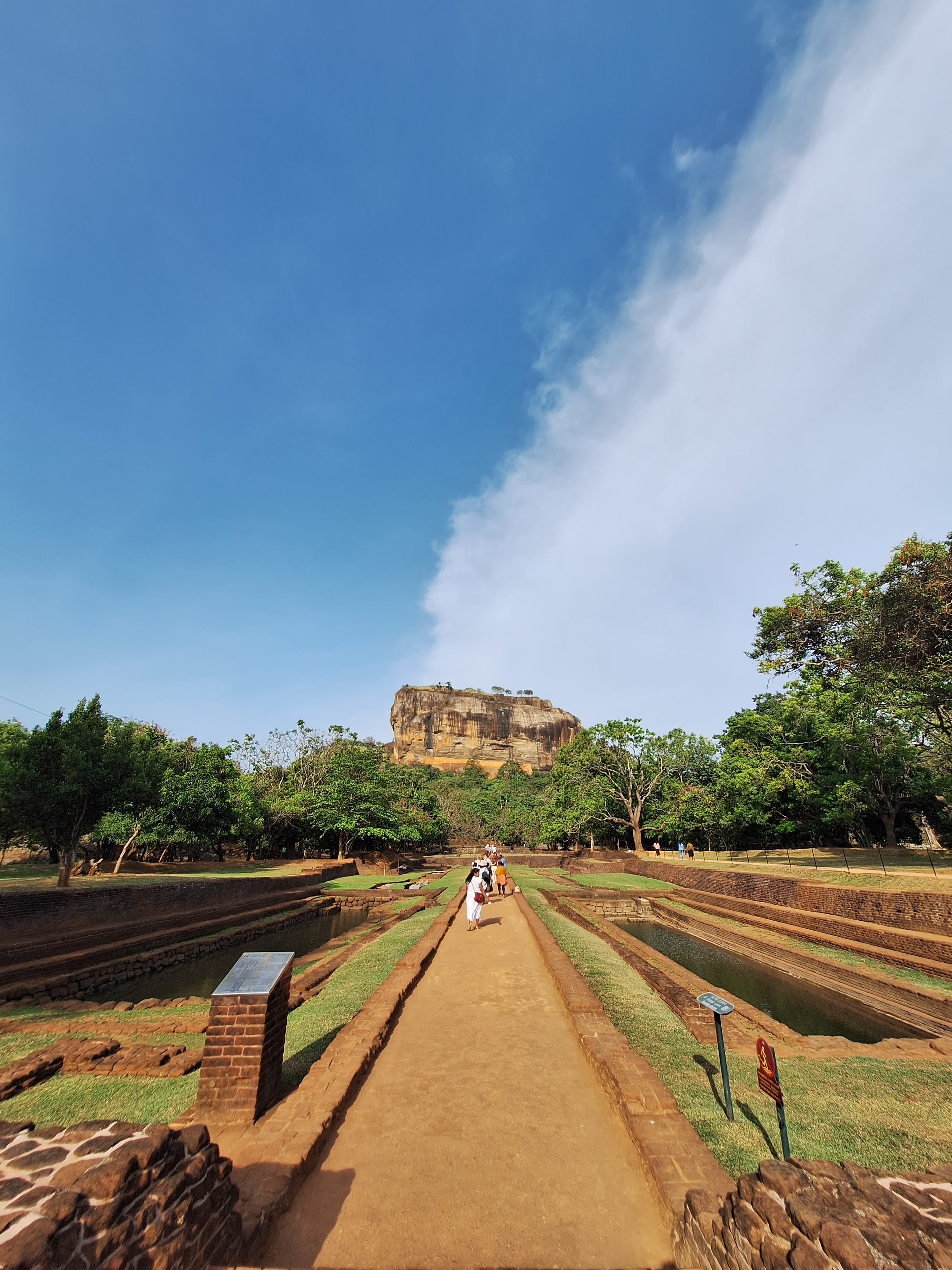 The grand central axis walkway running through the world-famous Water Gardens of Sigiriya. Flanked on both sides by precision-cut, stone-lined pools, terraces, and hidden underground clay pipes, this hydraulic complex stands as a monumental testament to 5th-century engineering.
- The Magic Fountains: In the water gardens at the base of the rock, you will pass limestone fountain plates. During the rainy season, the natural water pressure built up in the underground channels causes these fountains to clear out and spray water symmetrically—entirely powered by gravity, without a single modern pump.
The Art: The Ethereal Sigiriya Frescoes
Halfway up the rock face, sheltered in a natural depression protected from the elements, lies a gallery of ancient art that will take your breath away.
Known as the Sigiriya Frescoes, these vibrant paintings depict elegant, stylized women adorned with heavy jewelry and tiaras, holding trays of flowers. Shrouded in mystery, historians debate whether they represent King Kashyapa’s numerous concubines or celestial nymphs (Apsaras) hovering in the clouds. Originally, a vast swath of the rock face was covered in these paintings, creating an enormous, open-air art gallery. Today, only a precious few remain, preserving a flawless look into 5th-century aesthetic mastery.
Katapath Pawura (The Mirror Wall)
Just past the fresco gallery, you will walk along a sheer brick pathway shielded by an immaculate white wall. This is the famous Katapath Pawura, or the Mirror Wall.
In ancient times, this brick wall was coated in a highly specialized, fiercely polished glaze made of lime, egg whites, and wild honey. It was so reflective that King Kashyapa could literally see his own reflection as he walked past.
- Ancient Social Media: Over the centuries, long after the palace fell, travelers, poets, and monks visited the ruins. They etched their thoughts, feelings, and praises into the wall’s plaster. Known as the Sigiri Graffiti, these verses date from the 6th to the 14th centuries. They provide invaluable historical insight into the evolution of the Sinhala language and the sheer awe the rock inspired in early explorers.
The Lion Paws & The Climb
The final ascent begins at the northern terrace, where you are greeted by two colossal stone lion paws carved directly into the rock face. Originally, a massive brick lion sat here, and visitors had to climb directly through the beast’s gaping mouth to reach the summit.
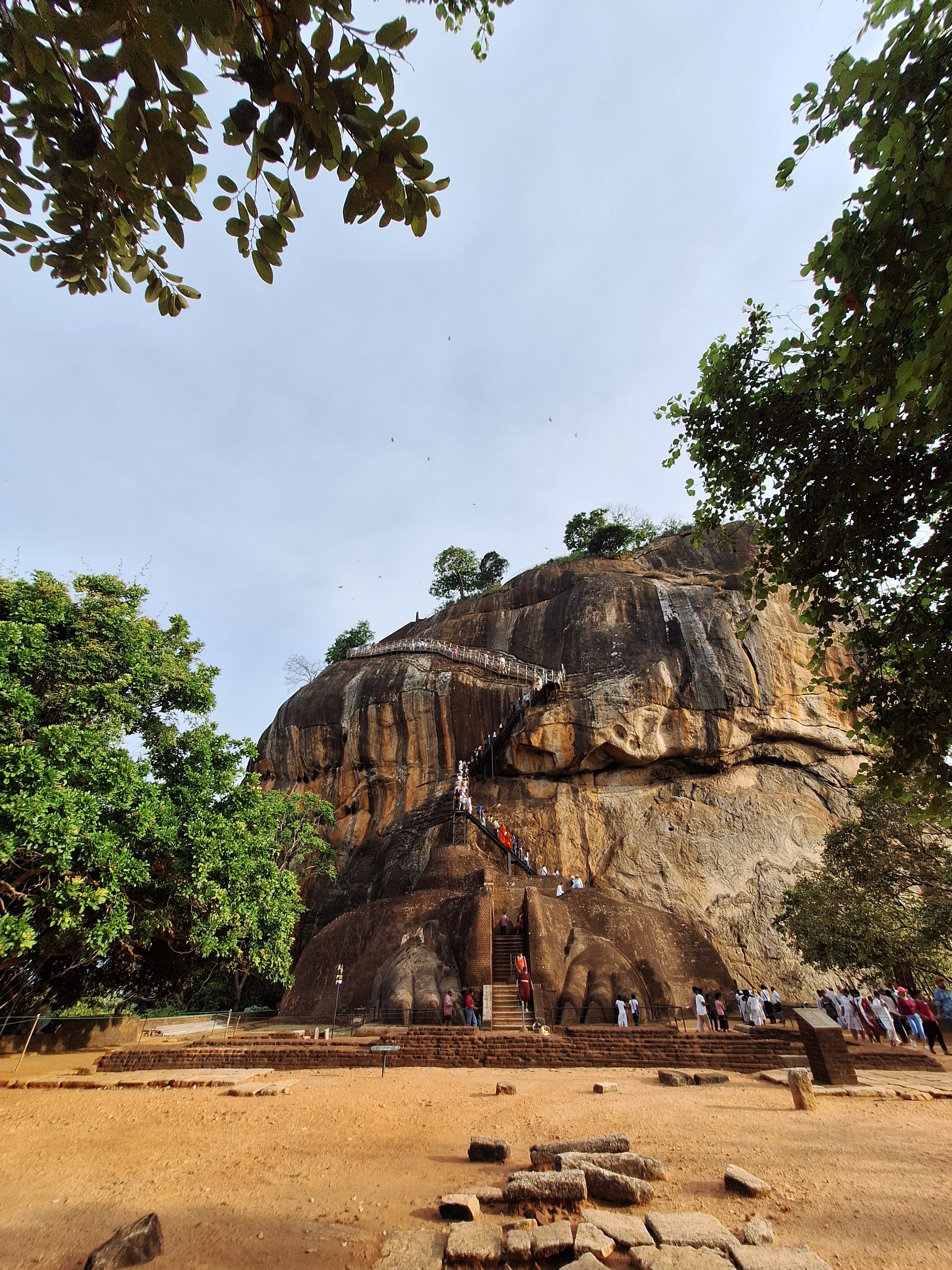 Standing on the northern terrace looking up at the imposing granite wall. Framed by lush trees, you can see the modern metal stairways securely bolted directly onto the sheer cliff face, carrying brave climbers to the summit.
Today, the 1,200-step trek takes you up a secure modern staircase wrapped tightly around the vertical cliffside. As you climb higher, the panoramic views of the open plains start to unfold beneath your feet.
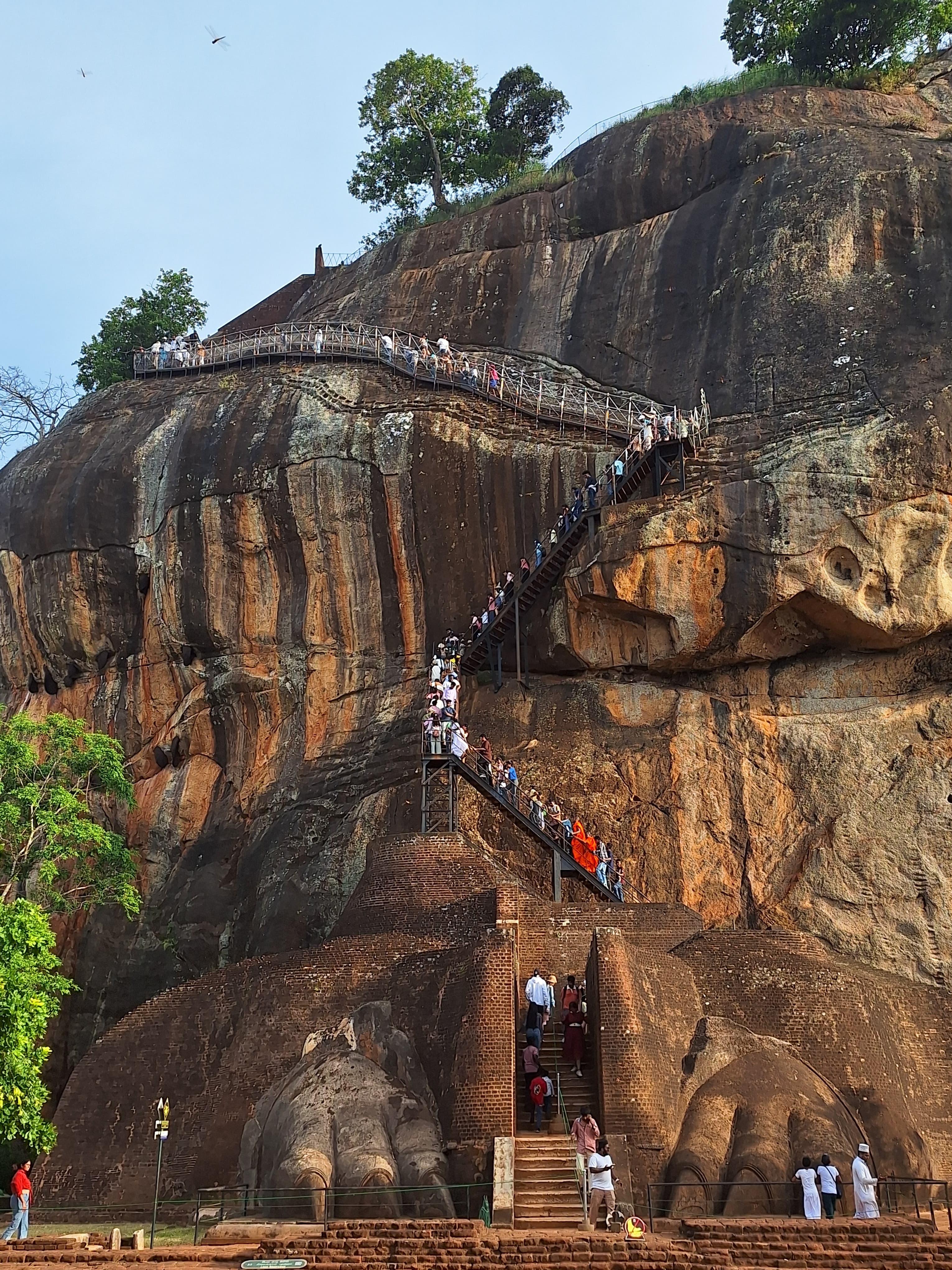 A detailed view of the Lion Paws Gate, showing travelers making the final, steep vertical climb. The two massive, ancient brick-and-plaster claws flank the central stone staircase, providing a dramatic entry point to the king’s upper palace.
The Summit Palace Ruins
Once you conquer the final stairs, you reach the absolute top of the rock. The summit contains the foundational ruins of King Kashyapa’s royal palace, complete with tiered stone terraces and his personal carved granite throne.
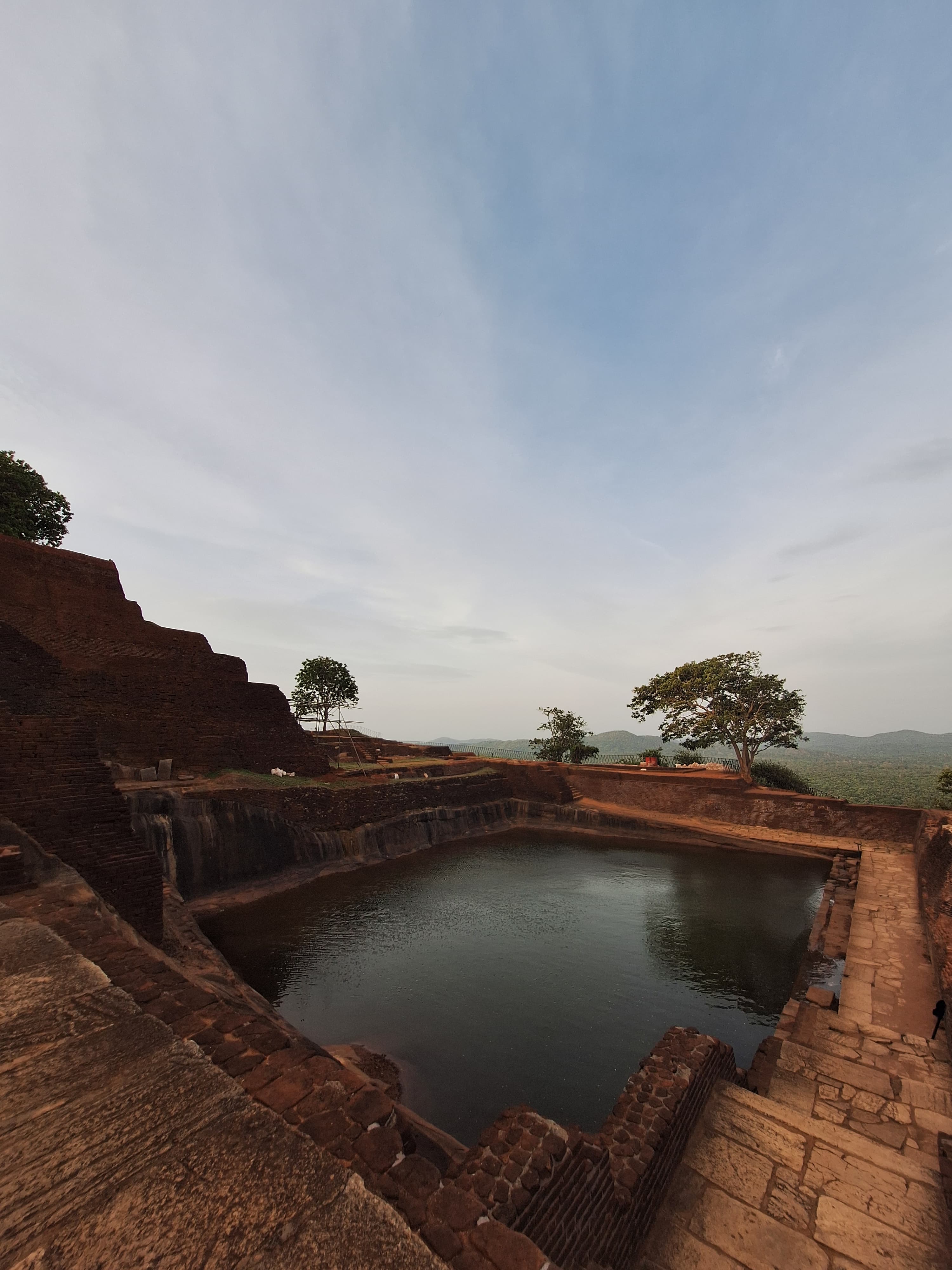 The massive, rock-cut royal swimming pool sitting at the very peak of the Sigiriya summit. Surrounded by tiered brick ruins and overlooking the boundless jungle horizon, this deep pool was fed entirely by rainwater and advanced gravity-fed engineering.
2. Pidurangala Rock (The Insider View)
While everyone goes to Sigiriya to climb the rock, travelers in the know go to Pidurangala to look at it. Located just a few kilometers down the road, Pidurangala offers a raw, rugged hiking experience that culminates in the best 360-degree panoramic view of Lion Rock itself.
The Historical Link: Pidurangala has its own ties to King Kashyapa. When the king arrived to build his fortress at Sigiriya, he had to relocate the Buddhist monks who were already living there. He built them a massive new monastery complex at the base of Pidurangala to compensate them.
The Scramble: The hike takes about 30 to 40 minutes. The first half is a relatively easy mix of forest trails and ancient monastery ruins, but the final stretch requires you to physically scramble over large boulders and tight gap openings. Wear good athletic shoes!
The reward at the top is completely unmatched. Standing on the wide, flat rock peak of Pidurangala gives you a flawless, eye-level gaze directly at the sheer majesty of the neighboring Lion Rock.
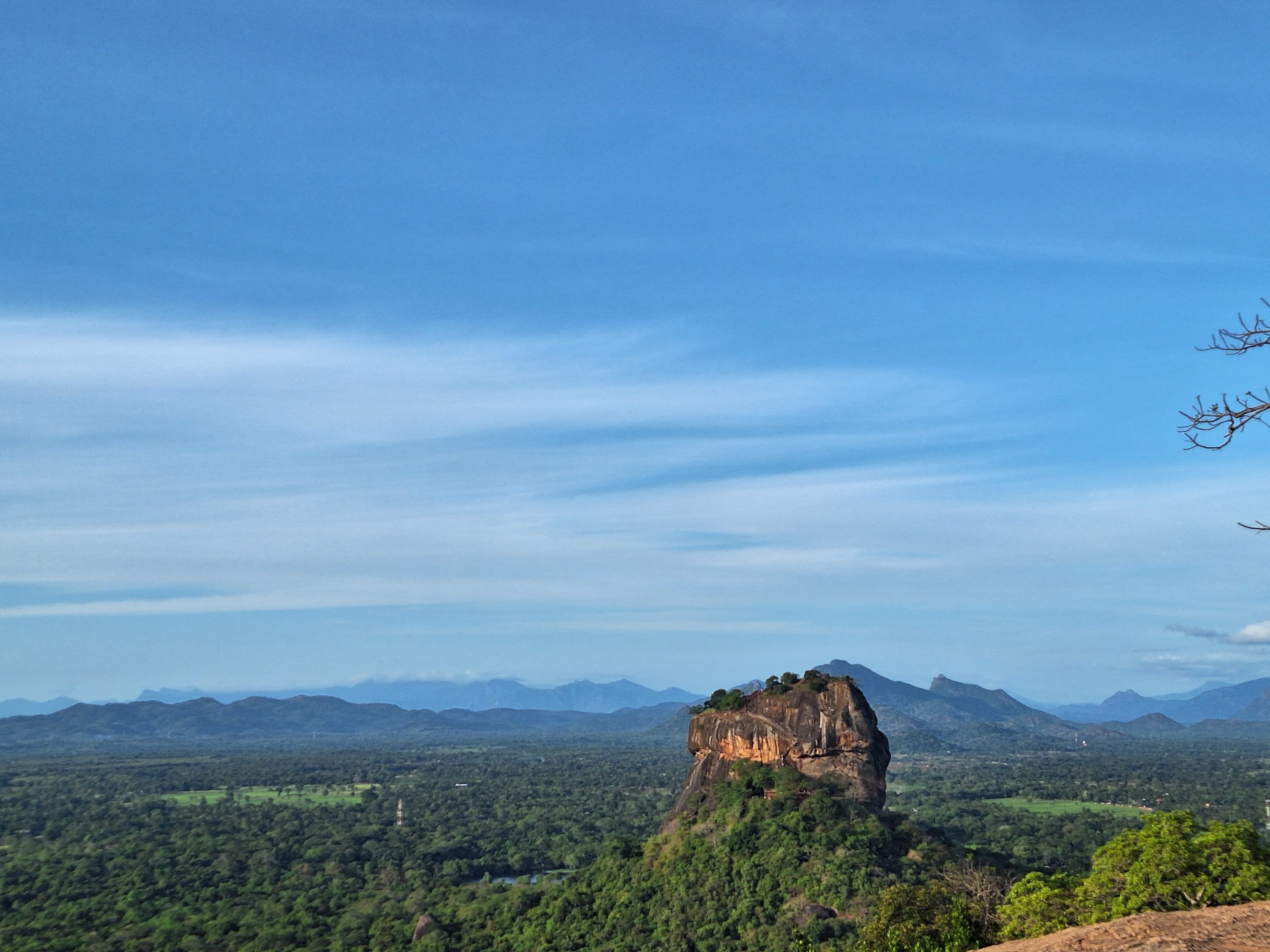 The iconic postcard shot taken from the high peak of Pidurangala Rock. Sigiriya stands proudly like an emerald-ringed monolith in the middle of flat, dense jungle plains, while layer upon layer of blue mountain ranges stretch far into the misty horizon.
Every angle from the open, boulder-strewn summit of Pidurangala offers a slightly different artistic framing of the landscape.
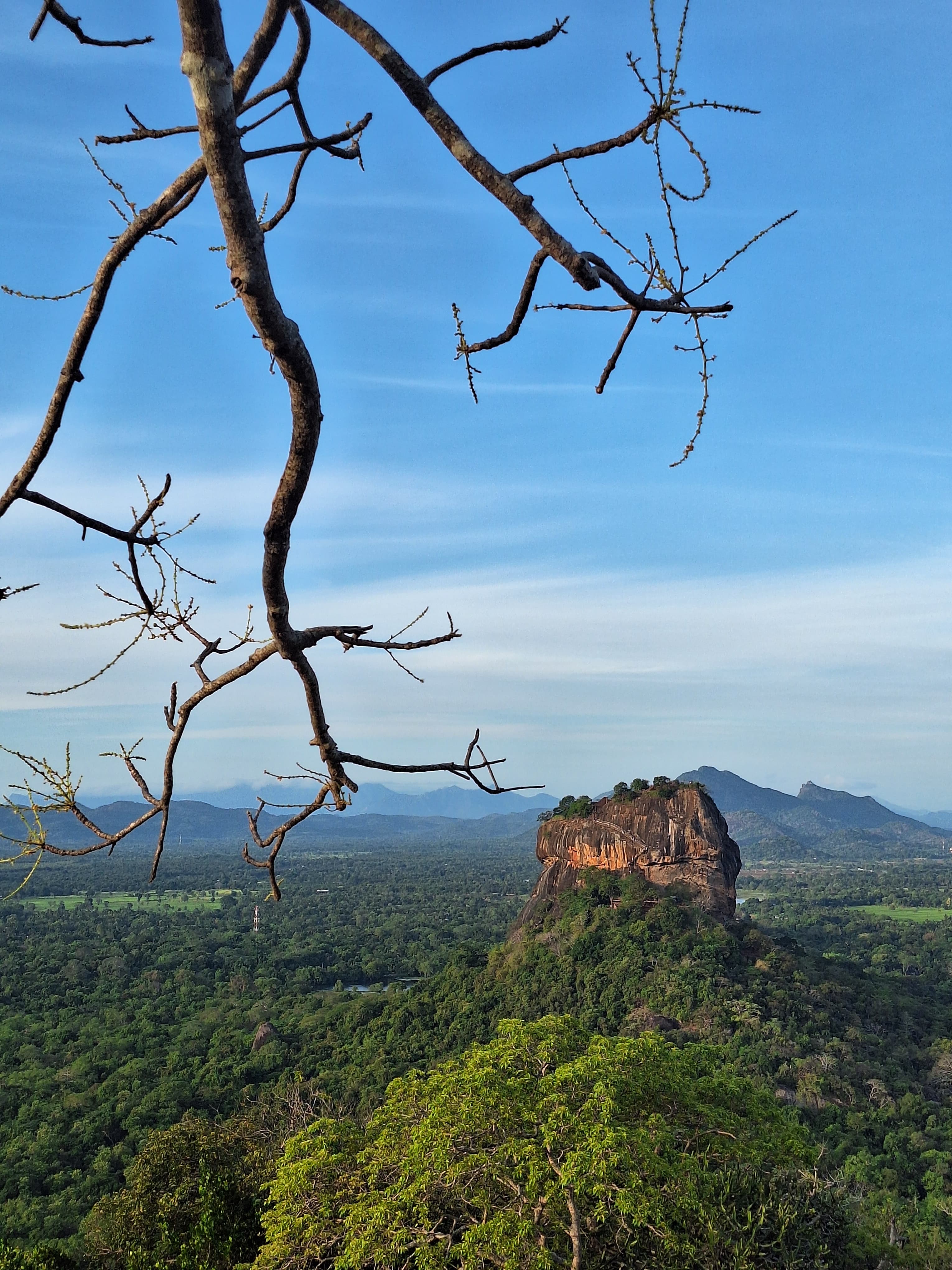 An artistic perspective of Sigiriya Rock framed by a bare tree branch extending from the Pidurangala summit. This shot beautifully contrasts the raw, untamed wilderness of the area against the historic form of the ancient palace rock.
Sweeping Horizons & Ancient Lakes
Looking away from Sigiriya Rock, the peak of Pidurangala reveals just how deeply interwoven the ancient Sri Lankan civilizations were with the surrounding natural environment.
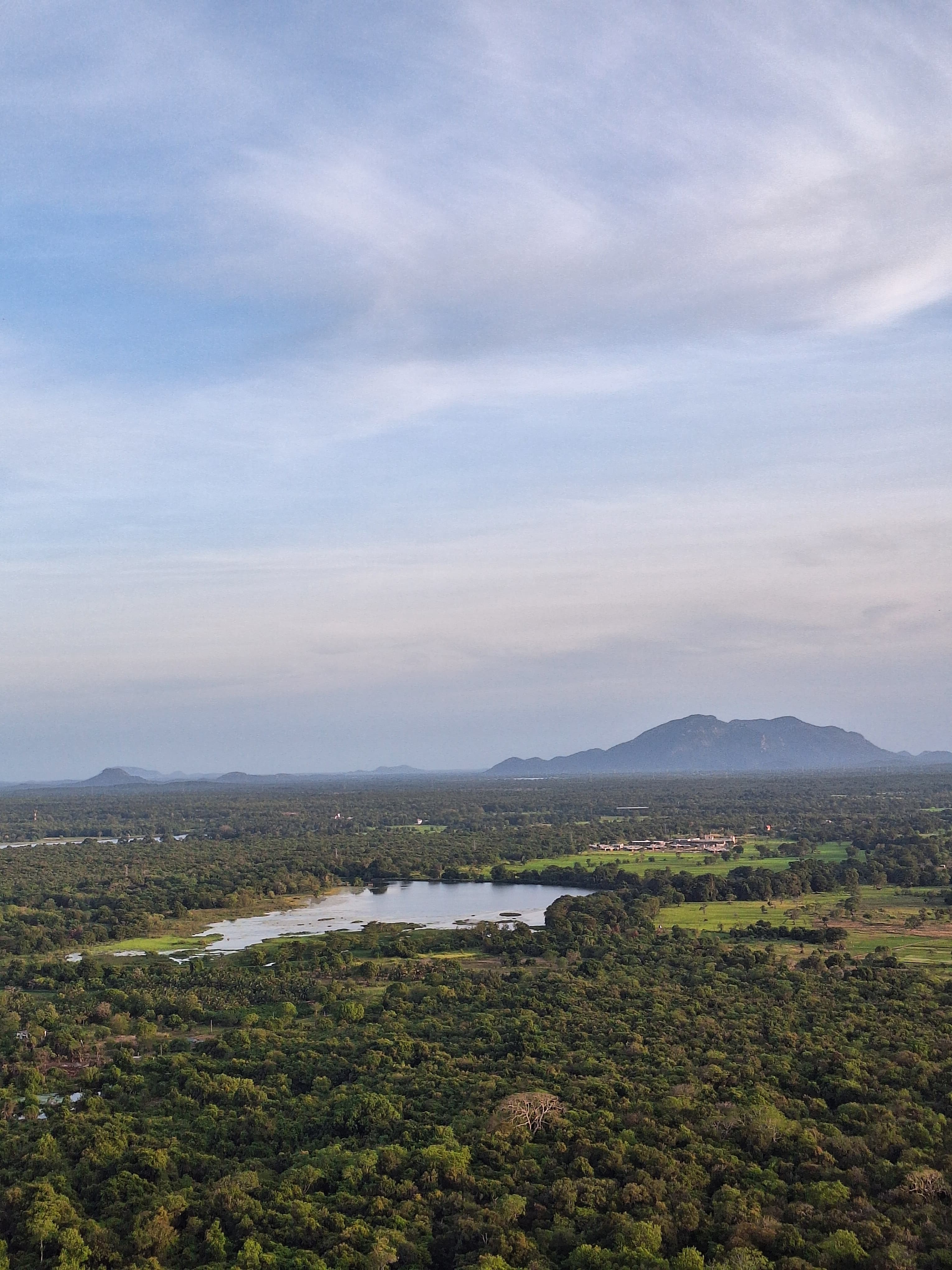 Gazing out toward the vast, flat lowlands from the edge of the peak. A calm, natural lake (or ‘wewa’) breaks up the endless sea of green jungle canopy, anchored in the far distance by a solitary mountain ridge.
The landscape is littered with these historic reservoirs, built by ancient kings to sustain agriculture and life in the dry zone.
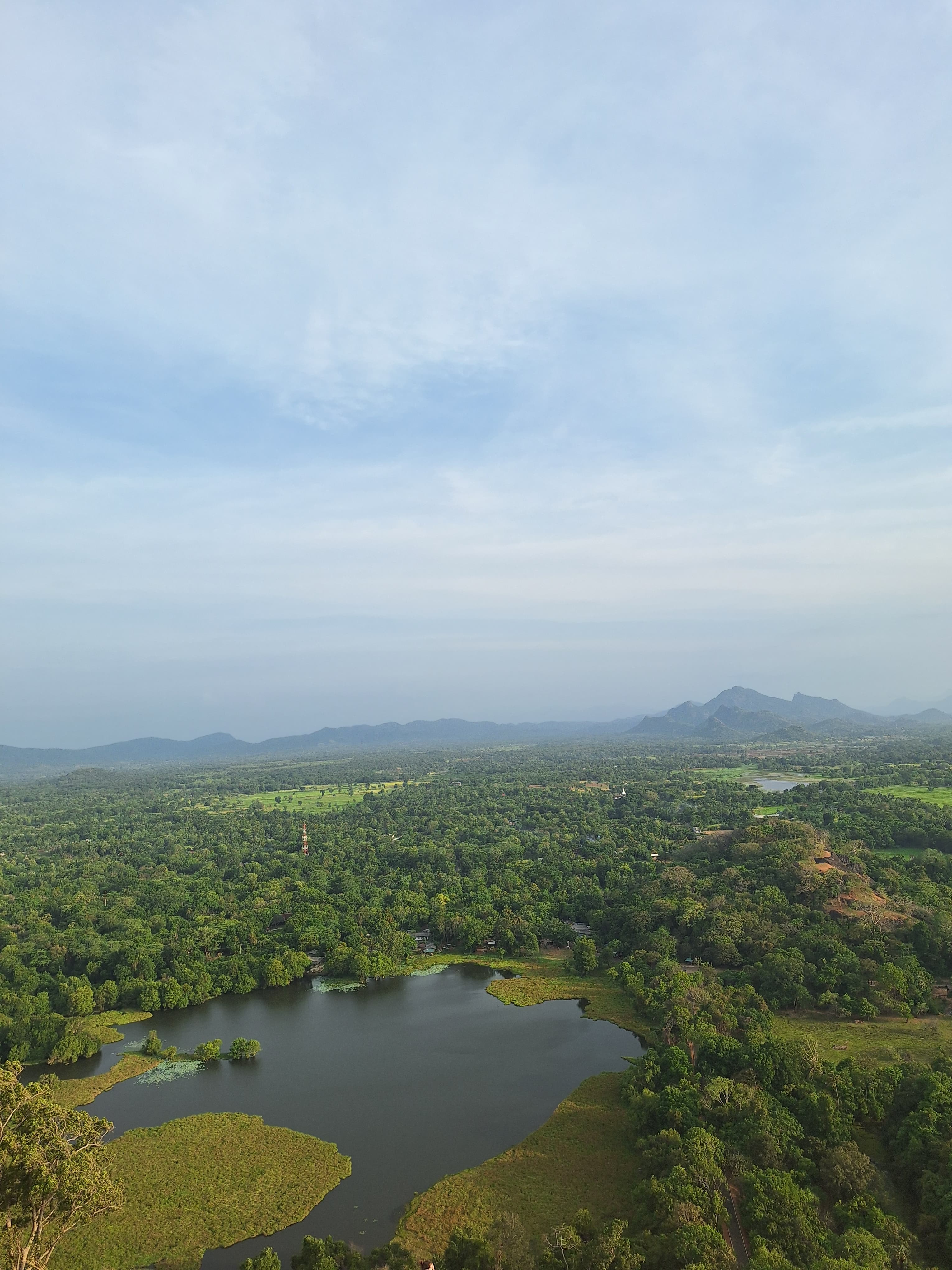 Another breathtaking panoramic view from the summit, capturing a large water reservoir winding gracefully through the forest. The gentle curve of the water reflects the sky, framed perfectly by distant mountains under a soft layer of clouds.
The Sunset Experience
If you time your hike correctly, staying on the peak of Pidurangala for sunset is an absolute spiritual experience.
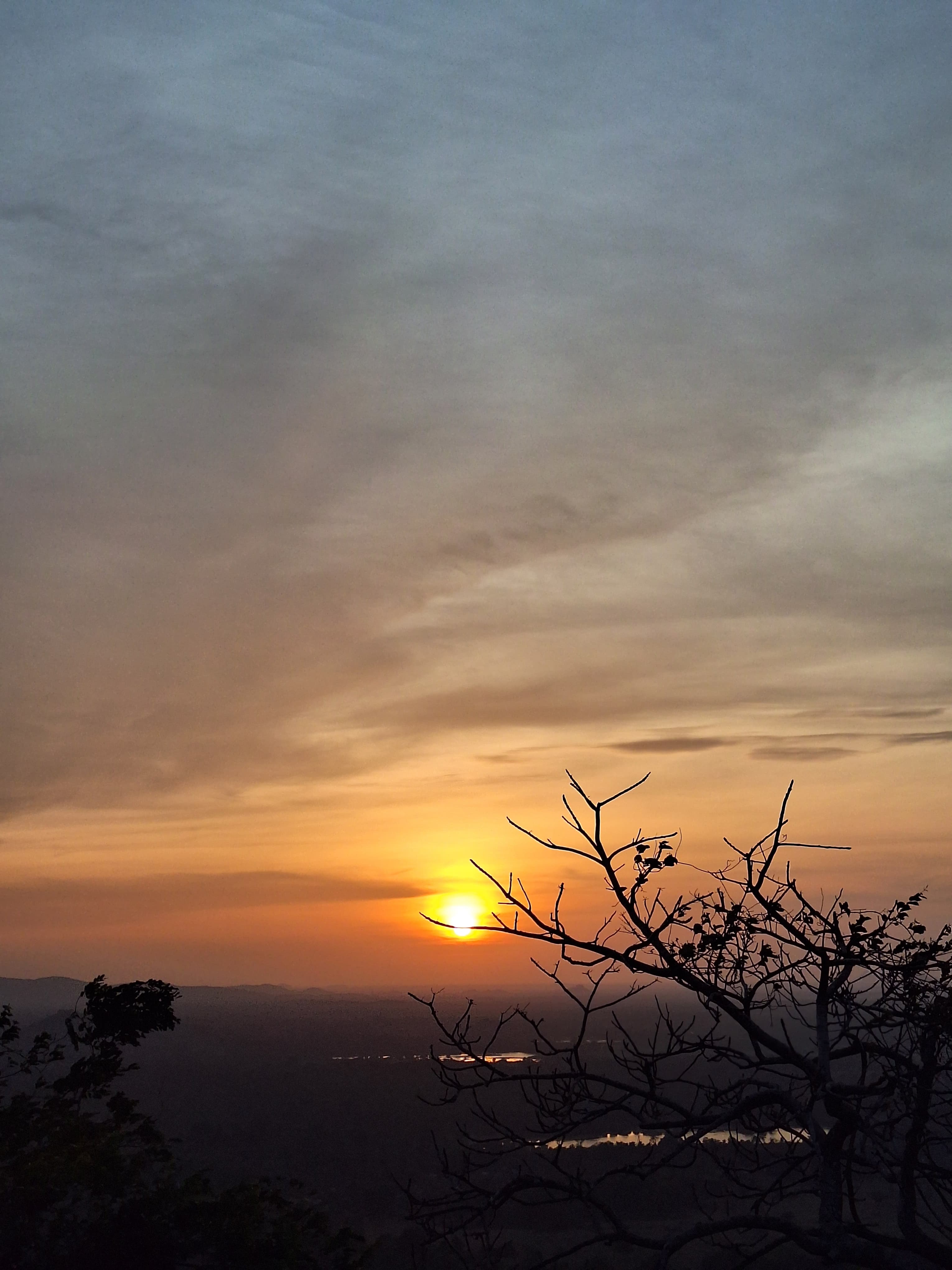 The ultimate reward for an evening scramble: watching a brilliant golden sun sink beneath a heavy layer of twilight clouds. The silhouette of local trees in the foreground captures the tranquil, wild atmosphere of a Sri Lankan evening.
3. Dambulla Cave Temple (The Golden Temple)
A short 30-minute drive south from Sigiriya brings you to Dambulla, home to the most impressive and well-preserved cave temple complex in Sri Lanka.
Carved into a massive, overhanging rock face that towers 160 meters above the surrounding plains, these five distinct caves are filled with more than 150 stunning Buddha statues, statues of Sri Lankan kings, and intricate religious murals dating back over 2,000 years. The sheer scale of the hand-painted ceilings, perfectly conforming to the contours of the live rock, is enough to rival the world’s greatest cathedrals.
- Note: Because this is an active holy site, modesty rules are strictly enforced. You must cover your shoulders and knees to enter, and shoes must be removed before crossing into the cave courtyards.
4. Sunrise Hot Air Balloon Rides Over Kandalama
If you want a true bucket-list experience that completely alters your perspective of the region, you need to see the Cultural Triangle from the sky. Most balloon flights launch just after dawn from the peaceful, lakeside shores of nearby Kandalama.
As you drift gently between tree-top level and several thousand feet up, the morning mist clears to reveal the glassy expanse of Kandalama Lake, the distant golden Buddha statue of Dambulla, and the striking silhouette of Sigiriya Rock floating like a monolith on the horizon. It’s incredibly peaceful, completely quiet except for the occasional roar of the burner, and worth every bit of the early wake-up call.
- Seasonality: Keep in mind that ballooning operations are heavily weather-dependent and generally pause during the monsoon window, typically running from late October through May.
5. Other Must-See Spots Nearby
If you have an extra day or two in the area, don’t rush off just yet—add these incredible experiences to your list:
Minneriya or Kaudulla National Park
Famous for “The Gathering.” Depending on the seasonal water levels, hundreds of wild Asian elephants migrate to the edges of the ancient reservoirs here between July and October. It is one of the most spectacular wildlife sights in all of Asia, allowing you to observe vast herds interacting naturally in the open wild.
Ritigala Archaeological Reserve
If you want to escape the crowds completely, head north toward Ritigala. It’s an ancient, deeply secluded Buddhist monastery complex half-buried in the dense jungle of a strict nature reserve. Walking through the dry-stone paths, sunken courtyards, and ruined meditation platforms feels less like a typical tourist site and more like an untouched archaeological expedition.
The Quick-Reference Cheat Sheet
| Experience | Cost (Approx.) | Best Time of Day | Ideal Vibe |
|---|---|---|---|
| Sigiriya Rock | ~$36 USD | 7:00 AM or 3:30 PM | Ancient History & Fitness |
| Pidurangala | Sunrise or Sunset | Adventure & Photography | |
| Dambulla Caves | Morning or Late Afternoon | Culture & Spiritual Art | |
| Hot Air Ballooning | ~$299 USD | 5:15 AM (Pre-dawn pickup) | Ultimate Bucket List |
Whether you are watching the sun push past the horizon from a wicker basket in the sky, or standing where kings once stood atop the Lion Rock, this corner of Sri Lanka leaves a lasting footprint on anyone who wanders through it.